undefined - Imgur-1

What is the AGM100?

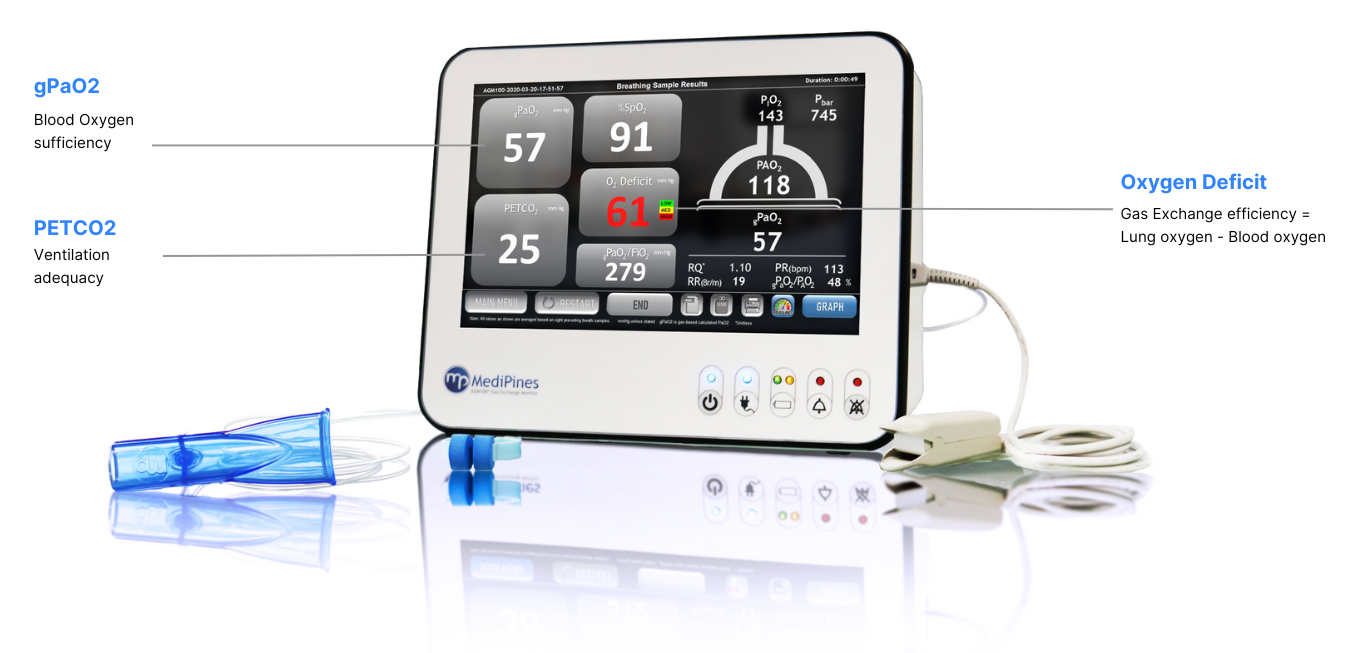
The MediPines AGM100 is the first of its kind, FDA Cleared, non-invasive pulmonary gas exchange analyzer. By providing instantaneous gas exchange measurements, physicians can assess and manage cardiorespiratory function of their patients much more accurately. The AGM100 measures critical parameters, such as blood and alveolar oxygen levels, with accuracy comparable to arterial blood gas (ABG) measurements; enabling faster clinical decision making and improved patient outcomes.

MediPines AGM100 Measurement Pointers

Why is Instant Gas Exchange Important?

Information on impaired gas exchange is key to gain more context on the patient's underlying condition. Having this information readily available enables physicians to make the most informed clinical decisions possible, eliminating doubt and uncertainty. 

Normal AGM100 Gas Exchange Measurement


Normal Gas Exchange

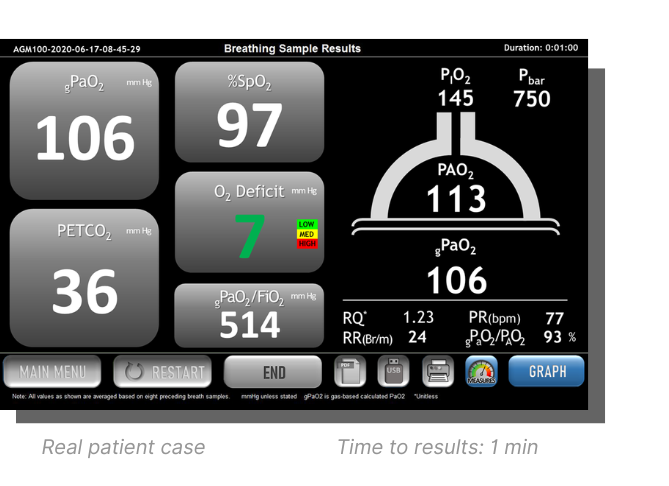
During steady-state breathing, a patient with no gas exchange impairment should exhibit a low Oxygen Deficit between 0-15 mmHg, which signifies little to no impairment between the alveolar oxygen level and the arterial blood oxygen level. In addition, normal CO2 levels (PETCO2) indicate adequte ventilation and high arterial blood oxygenation (gPaO2) indicate adequate oxygenation.

Abnormal AGM100 Gas Exchange Measurement


Abnormal Gas Exchange

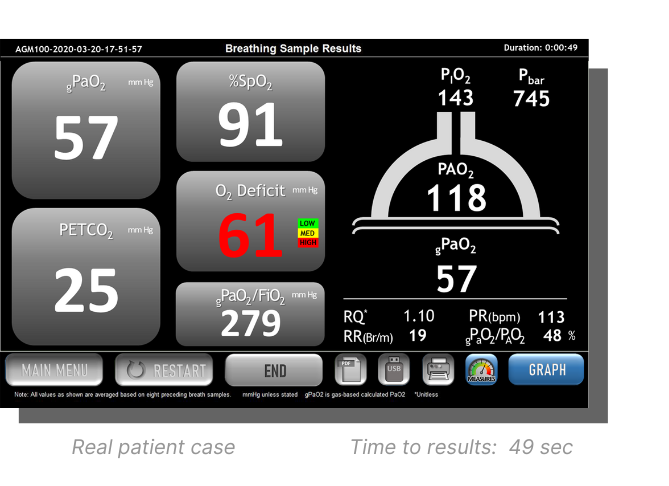
Patients with moderate to severe respiratory impairment will display an elevated Oxygen Deficit (PAO2 - gPaO2), which indicates gas exchange impairment. Reduced CO2 levels (PETCO2) shows mild hypoventilation, with low arterial blood oxygenation (gPaO2) indicate moderate hypoxemia. This patient is hypoxic, likely due to a problem with V/Q mismatch or diffusion limitation.

Immediate Clarity for Informed Decisions

Get more context on your patient's true cardiorespiratory condition with gas exchange measurements. With immediate non-invasive results at the point of care, you spend less time waiting, and more time making decisions. Efficient diagnosis means more effective allocation of resources and earlier discharge for cardiorespiratory patients.

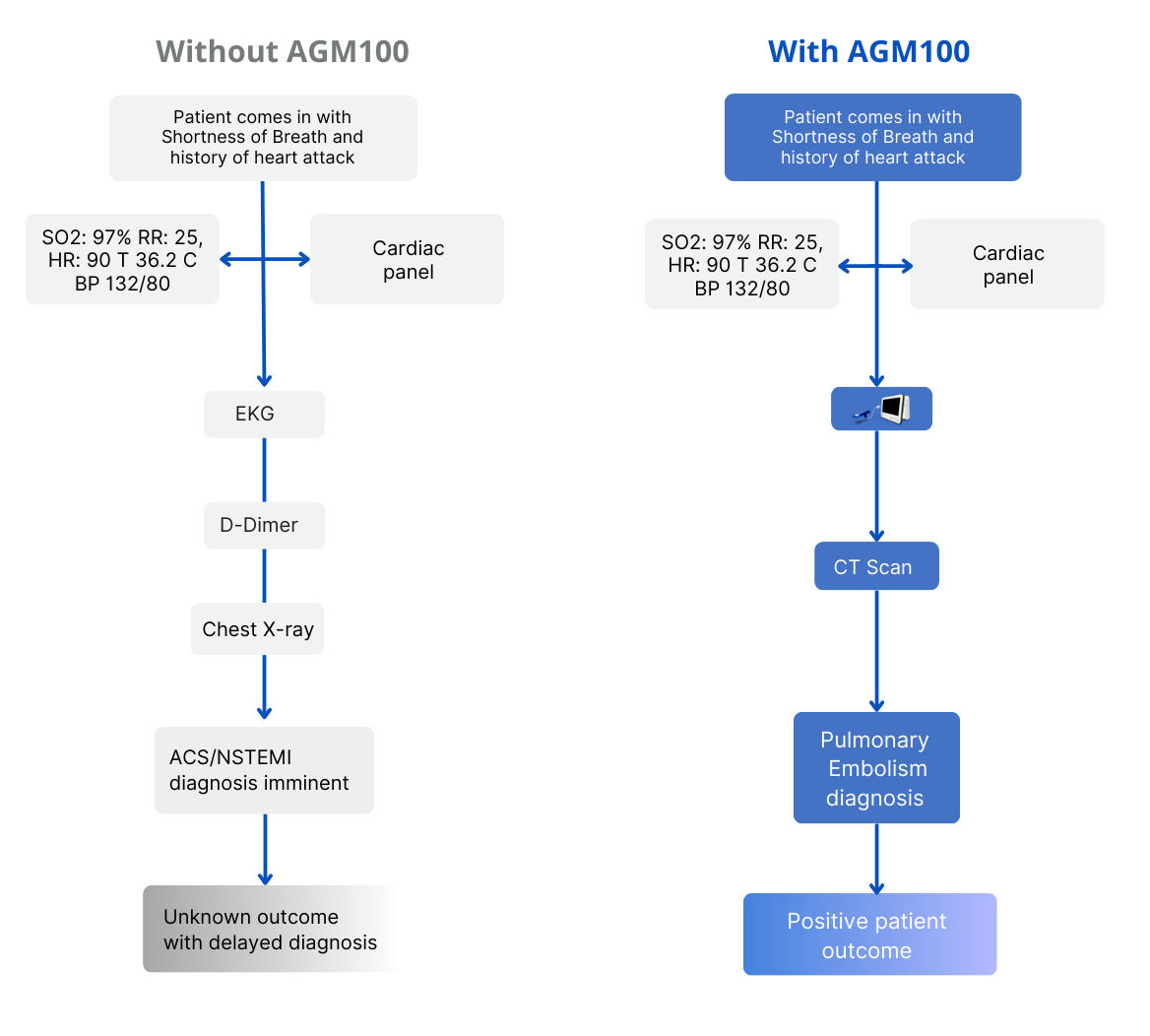
AGM100 Comparison with vs without

AGM® Gas Exchange Measurements

Symbol Description
Oxygen Deficit Gas exchange inefficiency (PAO2-gPaO2), mmHg
gPaO2 Calculated arterial partial pressure of oxygen, mmHg
PAO2 End-tidal oxygen partial pressure, mmHg
PETCO2 End-tidal carbon dioxide partial pressure, mmHg
gPaO2/ FiO2 Ratio of arterial partial pressure of oxygen to fraction of oxygen inspired
gPaO2/ PAO2 Arterial to alveolar partial pressure of oxygen exchange ratio
SpO2 Blood oxygen saturation, %
Respiratory Rate (RR) The number of breaths per minute
Pulse Rate (PR)
The number of heart beats per minute
RQ Respiratory quotient, ratio of carbon dioxide produced to oxygen used
PiO2 Partial pressure of inspired oxygen, mmHg
Pbar Barometric pressure, mmHg


Demonstrated Clinical Accuracy

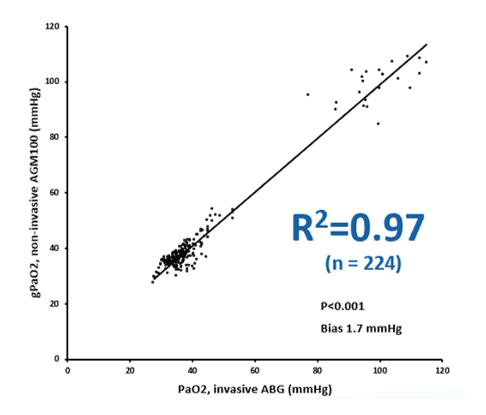
Precision in cardiorespiratory assessment is vital, and the MediPines AGM100 achieves this with comparable accuracy to Arterial Blood Gas Analysis. This near 1:1 relationship guarantees accurate and dependable measurements for better patient outcomes.

abg agm100 comparison

Oxygenation, Ventilation, and Gas Exchange Measurements in One Breathing Session

Essential Clinical Insights, Non-Invasively Delivered Instantly at the Point-of-Care

background-video-mp

Pulmonary gas exchange is critical for our health- as shown in the lungs' tiny alveoli. Here, oxygen is absorbed into the blood, and carbon dioxide is released to be exhaled. This natural process of gas movement in the body, called diffusion,  occurs in 500 million alveoli and ensures our blood is oxygen-rich for circulation.

The AGM100 technology leverages this principle, monitoring gas levels directly with advanced sensors combined with computational means to enhance precision to aid in assessing patients' respiratory and cardiovascular health.  Vital clinical information, such as blood oxygenation, ventilation and gas exchange, that traditionally required time-consuming invasive procedures is now available at the point-of-care with the AGM100. 

  • Gas Exchange

    Assessing respiratory impairment in patients is a critical aspect of clinical management. Traditionally, the Riley method (A-a gradient) has been the gold standard measure for gas exchange efficiency, but this approach...

    Read more


  • Clinical Accuracy

    Clinicians know that unlike other tests, the AGM100 provides accurate measurements of gas exchange impairment to differentiate healthy and sick patients...

    Read more


  • Operational Efficiency

    Patients in respiratory distress require immediate medical attention. The ability to quickly identify hypoxemia is crucial...

    Read more

What Physicians are Saying

“An Oxygen Deficit of 40 mmHg or above predicted a need for supplemental oxygen at some point during that hospital course with, essentially, 99% accuracy. The area under the curve of the receiver operating characteristic curve was 0.99.​”

Medscape Emergency Medicine Interview

"We're measuring these patients in the ER as a form of triage, to determine what kind of care we're going to provide. And then once the patient is admitted, we're monitoring these patients at least twice a day, to trend their responses to care and therapies. So far, its been extremely successful. We’re intervening much quicker to find out what it is that's going on, and then treating them..."  

Milwaukee Hospital Head of Respiratory

"With AGM100 alone, I can manage her... I'm not depending on my clinical impression, I'm depending on objective science now. I have tests to guide my clinical suspicion."

Ascension Affiliated Pulmonologist

Use AGM100 to detect impairment

Identify the degree of respiratory impairment to improve clinical decision making

Frequently Asked Questions

Still have more? Feel free to reach out directly. 

What is Oxygen Deficit?

Oxygen Deficit is the difference between the oxygen concentration in the alveoli (PAO2) and the oxygen concentration in the arterial blood (gPaO2). It represents the degree of severity of impairment in gas exchange and can be analogous to a non-invasive A-a gradient. As Dr. John B. West states, "Oxygen Deficit is the most informative measure of gas exchange."

How compliant are patients with the AGM100 testing?

The AGM100 has a very a high patient compliance rate. Its non-invasive, pain-free, and easy-to-use design ensures that patients are comfortable and cooperative during testing, making it a reliable choice for frequent spot checks.

How difficult is it to test and interpret an AGM100 measurement?

Learning how to perform a test and interpret the results on the AGM100 takes less than an hour of training. The AGM100 parameters are all measurements that healthcare providers are already familiar with, making interpretation straightforward. 

Latest Articles from our Blog

Get the latest news on MediPines as we continue to advance respiratory medicine.